

Key Takeaways
- Meta and Shopify both report accurately — they just measure different things.
- Meta reports higher revenue via view-through credit, longer windows, and returning-customer crediting.
- Shopify reports the conservative number: confirmed orders, last-non-direct-click, 30-day lookback.
- Run the business on Shopify order data plus blended MER, not platform ROAS alone.
- Real red flags: duplicate events, sudden reporting shifts, Meta purchases exceeding Shopify orders.
Every account review starts the same way. "Meta says we're at 4.2 ROAS. Shopify says our marketing sales don't come close to that." Then someone asks which number is wrong.
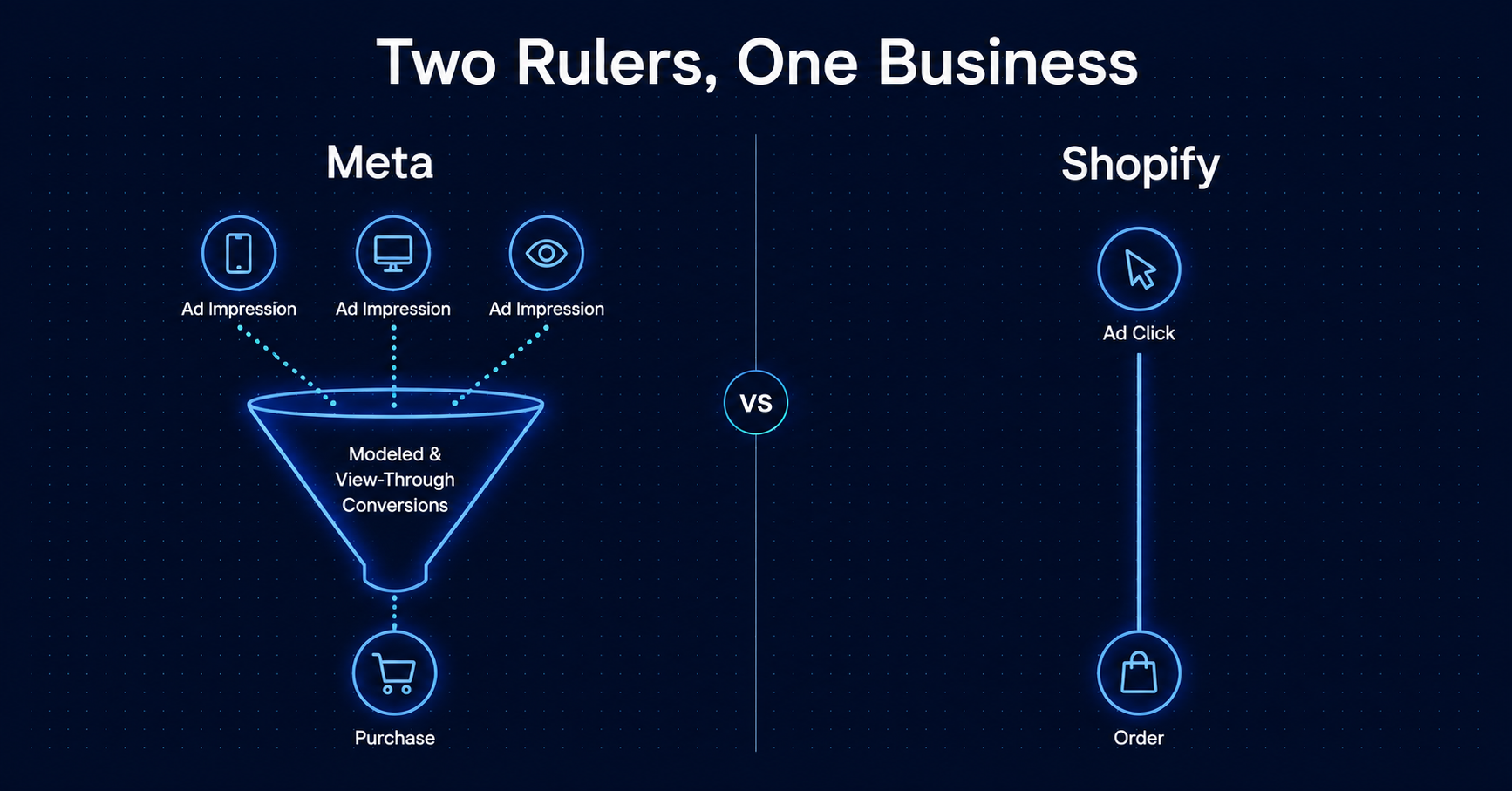
Neither number is wrong. Meta and Shopify are answering different questions using different rules, and expecting them to match is like expecting two different rulers, one in inches and one in centimeters, to show the same number on the same object. Once you understand what each platform is actually counting, the "discrepancy" stops being a mystery and becomes a predictable, explainable gap.
This guide breaks down exactly what Meta and Shopify are each reporting, why the gap forms, which number should actually run your business, and how to build a reconciliation process that stops the monthly "why don't these match" conversation for good.
Not Sure Which Number to Trust?
Book a free strategy session and we'll walk through your Meta, Shopify, and blended reporting together, line by line.
Book a Free Strategy Session →Table of Contents
- Why Meta and Shopify Rarely Match
- What Meta Is Actually Reporting
- What Shopify Is Actually Reporting
- Common Reasons Meta Reports More Revenue
- Common Reasons Meta Reports Less Revenue
- Which Number Should Run the Business?
- A Practical Attribution Hierarchy
- How to Reconcile Meta and Shopify
- Red Flags That Indicate a Real Tracking Problem
- Attribution Reconciliation Template
- Final Takeaway
- FAQ
Why Meta and Shopify Rarely Match
Meta and Shopify rarely match because they use different attribution models, different event timestamps, and different definitions of what counts as a "conversion" — Meta credits itself for view-through activity and cross-device journeys that Shopify's click-based reporting never sees.
Five structural differences drive almost every discrepancy you'll see:
- Different attribution models. Meta uses its own multi-touch modeling. Shopify's default marketing reports use last-non-direct-click.
- Different event timestamps. Meta logs the conversion against the day the ad interaction happened; Shopify logs the order against the day it was placed. A late-night purchase can land on different calendar days in each system.
- View-through attribution. Meta can credit a purchase to an ad someone merely saw, never clicked. Shopify has no equivalent.
- Cross-device journeys. Someone sees an ad on mobile, buys on desktop later. Meta can stitch that together probabilistically; Shopify's session-based tracking often can't.
- Returning customers. Meta may credit a new ad exposure for a repeat purchase Shopify simply logs as another order from an existing customer.
- Tracking loss. Ad blockers, iOS privacy restrictions, and cookie consent choices mean neither platform sees 100% of the customer journey.
What Meta Is Actually Reporting
Meta's reported "Purchases" and revenue figure combine click-through conversions, view-through conversions within your attribution window, and modeled conversions the system infers from Aggregated Event Measurement when it can't directly observe the user.
What's Inside Meta's Purchase Number
- Click-through conversions — someone clicked the ad and purchased within your attribution window
- View-through conversions — someone saw the ad, didn't click, and purchased within a shorter window (1-day view-through is the modern default for most accounts)
- Attribution window — the campaign-level setting (commonly 7-day click, 1-day view) that determines how far back Meta will look
- Modeled conversions — conversions Meta statistically infers under Aggregated Event Measurement when a user has opted out of tracking
- Event matching — how reliably Pixel and Conversions API events are matched to a known user profile, which directly affects how much Meta can attribute versus model
Meta documents how Aggregated Event Measurement handles opted-out iOS traffic directly in its Business Help Center guidance on iOS 14 impacts, and modeled conversions are a documented part of that system, not a tracking error.
What Shopify Is Actually Reporting
Shopify's marketing reports attribute confirmed store orders to a single channel using last-non-direct-click by default, with a 30-day lookback window, and no view-through credit — it counts what actually happened in the store, attributed conservatively.
- Store orders. Shopify counts confirmed orders, not ad interactions — it's grounded in what actually got purchased.
- Referral and session data. Attribution relies on UTM parameters and referrer data captured at each session.
- First and last interaction limitations. Shopify's default reports use a single-touch model, so only one channel gets full credit per order even when several touchpoints contributed.
- Direct and unattributed traffic. Returning customers who type your URL directly, or whose referrer data was lost, get logged as "Direct" — not credited to the ad that originally won them.
Shopify's own documentation on measuring marketing performance confirms the default model and lookback window directly — it's worth reading once so your team knows exactly what "Shopify's number" actually represents before comparing it to anything else.
Common Reasons Meta Reports More Revenue
Meta typically reports higher revenue than Shopify because view-through credit, longer attribution windows, and returning-customer crediting let it claim purchases that Shopify's click-based, single-channel model either misses or assigns to a different source.
Common Reasons Meta Reports Less Revenue
Meta can also under-report relative to Shopify when consent restrictions, Pixel or Conversions API gaps, and deduplication issues cause real purchases to go untracked entirely — those sales still show up in Shopify because the order happened, but Meta never sees the ad interaction behind it.
| Meta Reports More | Meta Reports Less |
|---|---|
| View-through credit on ads never clicked | Consent restrictions blocking event capture |
| Returning-customer purchases re-credited to a recent ad | Pixel and CAPI implementation gaps |
| Cross-channel overlap with email, organic, or affiliate | Event deduplication issues undercounting real purchases |
| Longer attribution windows than Shopify's 30-day lookback covers | Cross-device loss where the purchase device never saw the ad |
| Duplicate or faulty client-side tracking inflating counts | Checkout-domain or subdomain issues breaking the Pixel |
Which Number Should Run the Business?
No single number should run the business alone — platform ROAS optimizes campaigns, blended MER measures company-level efficiency, new-customer CAC measures acquisition health, contribution margin measures profitability, and incrementality measures which spend is actually causal. Each answers a different question.
- Platform ROAS — use it for in-platform optimization decisions: which ad set, audience, or creative to scale within Meta itself.
- Blended MER — total revenue divided by total ad spend across every channel. This is your best single read on whether marketing overall is efficient.
- New-customer CAC — isolates acquisition performance from repeat-purchase noise, which platform ROAS blends together.
- Contribution margin — tells you whether the revenue Meta or Shopify report is actually profitable once product, fulfillment, and payment costs are removed.
- Incrementality — the only metric that tells you what would have happened without the ad spend, via holdout tests or geo experiments.
A Practical Attribution Hierarchy
A clear attribution hierarchy treats Shopify order data as financial truth, blended channel data as the consistency check, platform-reported data as directional signal, and campaign-level metrics as tactical, day-to-day optimization input — each level informs a different kind of decision.
The Attribution Hierarchy, Top to Bottom
- Financial truth: Shopify order and revenue totals — what actually got sold, full stop
- Blended channel view: Total revenue against total spend (MER) across every channel combined
- Platform directional data: Meta's reported ROAS and CPA, used for in-platform decisions only
- Campaign and creative signals: Ad-set and creative-level metrics used for day-to-day optimization
How to Reconcile Meta and Shopify
Reconciling Meta and Shopify means validating your event implementation, checking for purchase duplication, comparing attribution windows side by side, separating new from returning customers, reviewing channel overlap, and building one consistent reporting model your whole team agrees to use.
Reconciliation Checklist
- Validate event implementation — confirm Pixel and Conversions API are both firing and deduplicating correctly in Events Manager
- Check purchase duplication — look for the same order counted twice across browser and server events
- Compare attribution windows — align Meta's campaign-level window against Shopify's 30-day lookback before drawing conclusions
- Separate new and returning customers — blended CPA hides whether Meta is actually acquiring or just re-crediting existing buyers
- Review channel overlap — check whether email, SMS, or affiliate campaigns are touching the same customers Meta is claiming
- Build a consistent reporting model — document which number answers which question, and get the team to stop comparing incompatible metrics
Red Flags That Indicate a Real Tracking Problem
Most Meta-versus-Shopify gaps are normal attribution disagreement, not a bug — but Meta purchases materially exceeding total Shopify orders, mismatched purchase values, duplicate events in Events Manager, or a sudden unexplained shift in reporting are genuine signals something in your tracking setup is broken.
When to Actually Worry
- Meta-reported purchases exceed total Shopify store orders for the same period — not just revenue, but order count
- Purchase value in Meta materially disagrees with Shopify's average order value, beyond what discounting explains
- Events Manager shows duplicate Purchase events firing for the same order
- Reporting suddenly shifts after a site, theme, or checkout change — usually a broken Pixel or CAPI connection, not an algorithm change
- Browser and server events aren't deduplicating, inflating both platforms' counts simultaneously
Meta's Conversions API is designed specifically to close the gap left by browser-only tracking, and Meta's own documentation on the Conversions API is the right first stop if event matching quality is part of what's driving your gap.
Want Us to Run This Reconciliation on Your Account?
We'll pull your Meta and Shopify numbers side by side and show you exactly where and why they diverge.
Attribution Reconciliation Template
A simple reconciliation template lines up Shopify's order total, Meta's reported purchases and revenue, the attribution window and model each platform used, and a plain-language note explaining the gap — so the same conversation doesn't happen from scratch every reporting cycle.
| Metric | Shopify | Meta | Notes |
|---|---|---|---|
| Order / purchase count | — | — | Compare counts, not just revenue |
| Revenue | — | — | Flag anything >20% apart for review |
| Attribution model | Last non-direct click | Meta multi-touch | Document, don't try to force a match |
| Lookback window | 30 days | Per campaign setting | Align before comparing |
| New vs. returning split | — | — | Blended CPA hides this |
Grab the Full Reconciliation Spreadsheet
The same working template we use internally to reconcile Meta and Shopify reporting for client accounts.
Final Takeaway
Meta and Shopify disagreeing isn't a tracking failure — it's two systems doing exactly what they're built to do, using different rules. Treat Shopify as your financial truth, blended MER as your efficiency signal, and platform ROAS as a tactical, in-platform tool, and the "which number is right" conversation stops being a monthly fire drill.
The accounts that get this wrong usually aren't misreading the data — they're asking one number to answer a question it was never built to answer. Fix the hierarchy, and the gap stops feeling like a problem and starts looking like exactly what it is: two rulers, two units, one business.
For the bigger picture of how attribution fits into a complete acquisition strategy, see our guide to building a full-funnel Meta Ads strategy. [INTERNAL LINK REQUIRED: Allowable CAC post, once published] and [INTERNAL LINK REQUIRED: MER vs. ROAS post, once published] will extend this reconciliation into a full efficiency framework as those pieces go live.
Find Out Whether Your Reporting Can Be Trusted
We'll run a full attribution and tracking review on your account — Pixel, CAPI, and Shopify reporting, side by side.
Book Your Free Call →No pressure. Just a straight read on where your numbers actually stand.
FAQ: Meta Ads Attribution vs. Shopify Sales
Why does Meta show more sales than Shopify?
Meta typically shows more sales because it credits view-through conversions, uses a broader attribution window, and can attribute purchases from returning customers to a recent ad exposure. Shopify's default reporting only counts confirmed orders on a single last-non-direct-click model with no view-through credit.
Is Meta ROAS accurate?
Meta ROAS is accurate for what it's measuring — platform-attributed revenue against platform spend, using Meta's own attribution rules. It's not a full picture of business profitability, and it isn't designed to match Shopify's order-based revenue, which uses a different, more conservative model.
Should I use Shopify or Meta to calculate ROAS?
Use Shopify order data as your source of financial truth for the business, and use Meta's platform ROAS for in-platform optimization decisions like which ad set or creative to scale. Neither should be used alone to judge whether marketing overall is working — blended MER answers that question better than either.
Does Meta count view-through conversions?
Yes. Meta can credit a purchase to an ad someone saw but never clicked, within a shorter view-through window than its click-through window. This is a documented part of Meta's attribution model, not a tracking bug, and it's one of the main reasons Meta reports more revenue than Shopify.
What attribution window should ecommerce brands use?
Most ecommerce accounts do well with a 7-day click, 1-day view attribution window at the campaign level, since it balances capturing real delayed purchases against over-crediting Meta for activity it barely influenced. The right setting still depends on your typical purchase consideration cycle.
How does Conversions API affect reporting?
Conversions API sends purchase events directly from your server to Meta, filling gaps left by browser-based Pixel tracking when ad blockers, cookie restrictions, or iOS privacy settings prevent client-side events from firing. Properly deduplicated CAPI implementation generally improves match quality and can shift reported numbers closer to reality.
What is the best source of truth for ecommerce revenue?
Shopify's confirmed order and revenue totals are the best source of financial truth, since they reflect what was actually sold rather than a modeled or credited attribution decision. Platform-reported numbers like Meta's ROAS should be treated as directional and tactical, not as the final word on revenue.
Why do GA4, Shopify, and Meta all disagree?
GA4, Shopify, and Meta each use different attribution models, different lookback windows, and different rules for crediting view-through activity and cross-device journeys. All three can be reporting correctly according to their own logic while still showing different totals for the same underlying orders.